
Home » How to Use the OBD2 Port In My Car
How to Use My Car’s OBD2 Scan Port and Whats Its Main Purpose
- Andrew Marks
- Car Wisperer
What It Does – How to Use It – Why It’s Essential for Smog Readiness and Repairs
Your car’s OBD2 scan port is the small, trapezoid-shaped plug beneath the driver’s side dash. That’s short for On-Board Diagnostics II.
Moreover, this port isn’t just for show—this small connector under your dashboard lets you connect directly to your car’s computer.
In fact, it’s more than just a random connector. Rather, it’s the gateway to your car’s onboard computer system, allowing technicians — and now everyday drivers — to access the same data that repair shops use to identify, monitor, and fix mechanical issues.
The Purpose of the OBD2 Scan Port
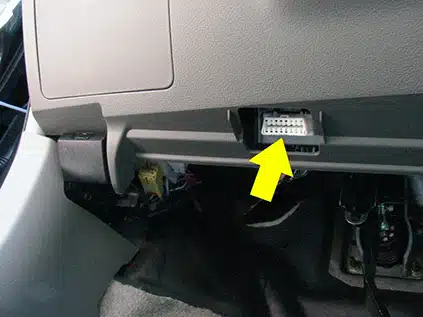
under the drivers side dash
When you plug an OBD2 scanner into the diagnostic port, usually found under the steering column, it powers up using the vehicle’s 12-volt supply and starts communicating with the Engine Control Unit (ECU). The ECU monitors engine performance, emissions, ignition timing, fuel delivery, and sensor data. The scanner works like a bridge, pulling stored info and live data straight from the vehicle’s computer.
Here’s What an OBD2 Scanner Can Do:
Read Diagnostic Trouble Codes (DTCs)
One main job of a scan tool is to pull fault codes when the Check Engine Light turns on. These codes appear when the ECU finds readings outside its normal range.
The scanner can display:
- Active codes are the ones currently triggering the warning light.
- Pending codes have been detected, but aren’t confirmed yet.
- Stored or history codes come from past problems.
Each code corresponds to a specific system issue. For example:
- P0171 – System Too Lean (Bank 1)
- P0300 – Random/Multiple Cylinder Misfire
- P0420 – Catalyst System Efficiency Below Threshold
While the code gives a clue, it doesn’t automatically tell you which part failed. To properly diagnose, you need to understand why the problem occurred.
View Live Sensor Data
Besides reading codes, scan tools let you monitor real-time engine data. The ECU continuously tracks sensor readings, and the scanner displays them while the engine is running.
Common live data parameters include:
- Air/Fuel ratio and fuel trim values
- Engine coolant temperature
- Oxygen (O2) sensor voltage
- Mass Air Flow (MAF) readings
- Manifold Absolute Pressure (MAP)
- Engine RPM and load
Watching live data while idling, accelerating, and cruising helps you spot unusual patterns. For example, very high fuel trim numbers might indicate a vacuum leak or weak fuel delivery, even if no code is displayed.
Perform System Tests and Bidirectional Control
More advanced scan tools can do more than read information — they can send commands to the ECU. This is known as active testing or bidirectional control.
Depending on the tool, you may be able to:
- Turn on the fuel pump.
- Turn cooling fans on and off.
- Open or close the EVAP purge valve.
- Activate the EGR system.
- Run injector balance tests.
This feature is important for checking whether a part responds correctly to ECU commands or whether the problem lies in wiring, sensors, or control modules.
Clear Codes and Reset the Check Engine Light
After repairs, the scanner can erase stored codes from the ECU’s memory, which turns off the Check Engine Light.
If the issue has been resolved, the light will remain off. If the fault persists, the ECU will detect it again and reset the code. It’s important to remember that clearing codes also resets the vehicle’s readiness monitors, meaning the car must complete a proper drive cycle before passing a smog or emissions test.
Monitor Long-Term Performance
- Check changes in fuel efficiency.
- Keep an eye on catalytic converter performance.
- Track fuel trim behavior over time.
- Confirm the system is ready for emissions testing.
- Make sure the repairs fixed the problem.
Over time, using this data helps you avoid guesswork and improve your diagnostic accuracy.
An OBD2 scanner gives you direct access to your vehicle’s operating data. Instead of just relying on warning lights, you get a clear view of how the engine and emissions systems are working, making diagnosis, maintenance, and repair much more accurate.
How the OBD2 Scan Port Works
The car’s ECU serves as the main processor for systems such as fuel delivery, ignition timing, emissions control, and idle management. When a part or sensor works outside normal limits, the ECU logs an error and turns on the Check Engine Light (CEL).
By connecting a scan tool to the OBD2 port, you can communicate with the ECU using standard protocols like CAN, ISO 9141, or SAE J1850. This allows the scanner to pull stored trouble codes, show live data, and test certain control modules.
Since OBD2 is federally standardized, this port is compatible with all vehicles sold in the U.S. since 1996, regardless of make or model.
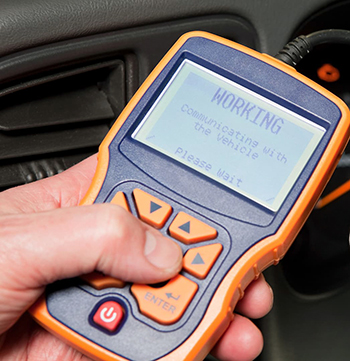
Using the OBD2 Scan Port for Smog Readiness
- The catalytic converter
- Evaporative emissions system (EVAP)
- Oxygen sensors
- EGR (Exhaust Gas Recirculation)
- Fuel system
- You recently cleared codes or disconnected your battery (which resets the monitors)
- You just completed repairs after failing a smog test.
- You want to verify system health before renewing registration.
Where to Find the OBD2 Port
- Alternatively, it may be behind a small cover panel or near the center console.
- In rare cases, it’s located near the passenger-side footwell.
Why the OBD2 Port Exists
However, in 1996, OBD2 was introduced to standardize vehicle diagnostics and improve nationwide emissions control.
Furthermore, today it’s not only a tool for mechanics but also for:
- First, DIY diagnostics and repair verification
- Second, fleet management and performance tracking
- Third, insurance telematics and emissions compliance
As a result of these advancements, the OBD2 port enables every car to monitor its own health and report it— a critical step toward modern vehicle intelligence.
Bottom Line
The OBD2 port connects you to your car’s onboard computer. It lets you easily check trouble codes, see live data, and make sure your car is ready for a smog test.
Anyone can use the OBD2 port to get a clear view of their car’s health, whether they are a professional or a regular driver.

Andrew Marks
Has been buying, selling, reconditioning and restoring cars since 2008. He is the owner of Los Angeles Cash for Cars, a trusted car buyer serving the greater Los Angeles area. With years of hands-on experience in used cars, classic car restoration, and automotive valuation, he’s passionate about educating the public on how to sell a car for cash or buy a reliable used vehicle with confidence.