
Home » My Car Failed the California Smog Check Now What?
Help, My Car failed the Smog Check — Now What Do I Do?
- Andrew Marks
- Car Whisperer
So, your car failed the smog check; you’re not alone. Every year, thousands of drivers find themselves in the same situation — standing at the test center wondering what to do next. The good news is, you have options. Whether you plan to repair, sell, or retire the car, understanding how the California Smog Check Program works can help you make the right decision.
Why Cars Fail the Smog Check
Top Six Reasons Why
The smog check tests your vehicle’s exhaust emissions to ensure it meets California’s strict air quality standards set by the California Air Resources Board. The inspection measures pollutants coming from your tailpipe and verifies that your emissions control systems are working properly. Cars can fail for a number of reasons, such as:
1. A faulty oxygen sensor or a failing catalytic converter
The oxygen sensor monitors the oxygen content of your exhaust and helps regulate the air-fuel mixture. If it sends incorrect data, your engine may burn too much fuel, increasing emissions. A failing catalytic converter won’t properly convert harmful gases (like carbon monoxide and nitrogen oxides) into less harmful substances, often causing a significant emissions spike.
2. An illuminated check engine light
If your check engine light is on, your vehicle will fail the smog test automatically, even if it seems to be running fine. This light indicates that the onboard diagnostic system (OBD-II) found a problem that may affect emissions, such as sensor issues, misfires, or EVAP system faults.
3. Poor fuel mixture or emissions control problems
Engines require a precise mix of air and fuel to run cleanly. Too much fuel (called running “rich”) or too much air (called running “lean”) can raise pollution levels. Issues with fuel injectors, fuel pressure regulators, or components such as the EGR valve can cause this imbalance.
4. Leaks in the EVAP system (which manages fuel vapors)
The Evaporative Emissions Control (EVAP) system stops gasoline vapors from escaping into the air. A loose gas cap, cracked hose, or broken purge valve can cause a failure because vapors aren’t properly contained or sent back into the engine.
5. Misfires or worn-out spark plugs
Engine misfires happen when the fuel in a cylinder doesn’t burn properly. This sends unburned fuel into the exhaust, greatly increasing emissions and potentially damaging the catalytic converter. Worn spark plugs, ignition coils, or ignition wires often cause this.
6. Dirty air filters or malfunctioning mass airflow (MAF) sensors
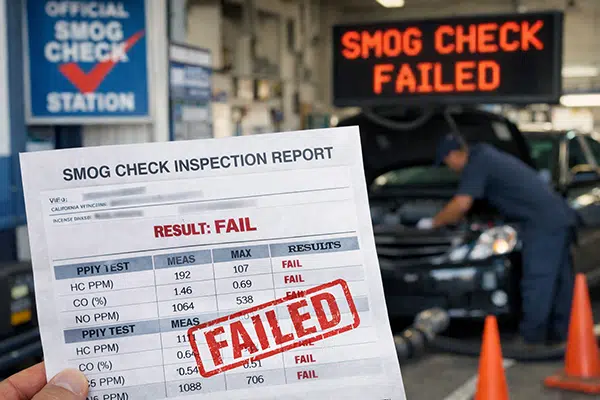
If your car fails, the technician will issue a Vehicle Inspection Report (VIR) listing the exact reasons it didn’t pass. Don’t ignore this — it’s your step-by-step guide to understanding what went wrong, what needs to be repaired, and how to prepare your vehicle for a successful retest.
What to Do if Your Car Fails the Smog Check
Your Five Best Options
1. Review the Results and Diagnose the Problem
The first step after a failed smog check is to carefully review your inspection report. If the report lists “OBD2 readiness not complete,” it means the onboard computer isn’t ready for testing — often after a battery disconnected or a recent repair. You may need to drive the car a few days before retesting.
If your car failed for excessive emissions or a check engine light, it’s time to visit a licensed smog repair shop or a STAR-certified test-and-repair center. These facilities specialize in diagnosing emissions issues and can provide repair estimates.
2. Decide Whether to Repair or Sell the Vehicle
Sometimes repairs are straightforward and affordable — like replacing an oxygen sensor or gas cap. Other times, especially with older or high-mileage vehicles, the needed repairs can cost more than the car is worth.
Before spending hundreds or thousands of dollars, compare the repair estimate to your car’s current market value. You can use tools like Kelley Blue Book or Edmunds to see what your car is worth in good condition.
If repairs don’t make financial sense, it might be time to consider selling your car as-is or retiring it through a state-approved program.
3. Explore Financial Assistance or Vehicle Retirement Programs
California’s Bureau of Automotive Repair (BAR) runs the Consumer Assistance Program (CAP) to help vehicle owners who don’t pass smog checks. Depending on your income and eligibility, you could get up to $1,200 to help cover repair costs.
If the car isn’t worth fixing, you may be eligible for the Vehicle Retirement Program, which pays qualifying owners to retire or scrap their vehicles. These programs help reduce emissions while giving car owners a cost-effective solution.
Visit www.bar.ca.gov for details and application forms.
4. Consider Selling Your Car “As-Is”
If your car won’t pass smog and you want to skip repairs, you can still sell it without a smog certificate, but only in some situations.
- You also need to tell the buyer that the car didn’t pass the smog test.
- The car can’t be registered until it passes smog. The buyer will have to either fix the car or work out a deal with the seller before moving forward.
- Some local buyers, such as Los Angeles Cash for Cars, buy running cars that don’t pass smog tests. They handle all the paperwork and pay cash the same day, with no testing, waiting, or DMV hassle.
With these options, this is the quickest and easiest way to get rid of a car that’s too expensive to fix.
5. Don’t Ignore It
Failing a smog test in California isn’t the end of the road. It’s a signal that something in your car’s emissions system needs attention. If repairs are affordable, fixing the issue will improve performance and fuel efficiency. But if your car is older, high-mileage, or too costly to repair. Selling it “as is” to a licensed local car buyer may be the smarter move.
Final Considerations
Failing a smog check in California doesn’t have to be stressful — it simply means your car’s emissions system may need attention. If repairs are manageable, fixing the problem can boost performance and fuel efficiency. However, if your car is older, has high mileage, or needs expensive repairs, selling it “as is” to a licensed car buyer could be the practical solution.
If repairs are too costly or impractical, Los Angeles Cash for Cars can help. We buy running and driving vehicles—even those that won’t pass smog. We provide a fair cash offer, handle all the paperwork, and make selling fast and worry-free.
To get started, call or text (310) 893-0162 today for a quote and get paid cash for your car—even if it failed the smog test.

Andrew Marks
Has been buying, selling, reconditioning and restoring cars since 2008. He is the owner of Los Angeles Cash for Cars, a trusted car buyer serving the greater Los Angeles area. With years of hands-on experience in used cars, classic car restoration, and automotive valuation, he’s passionate about educating the public on how to sell a car for cash or buy a reliable used vehicle with confidence.